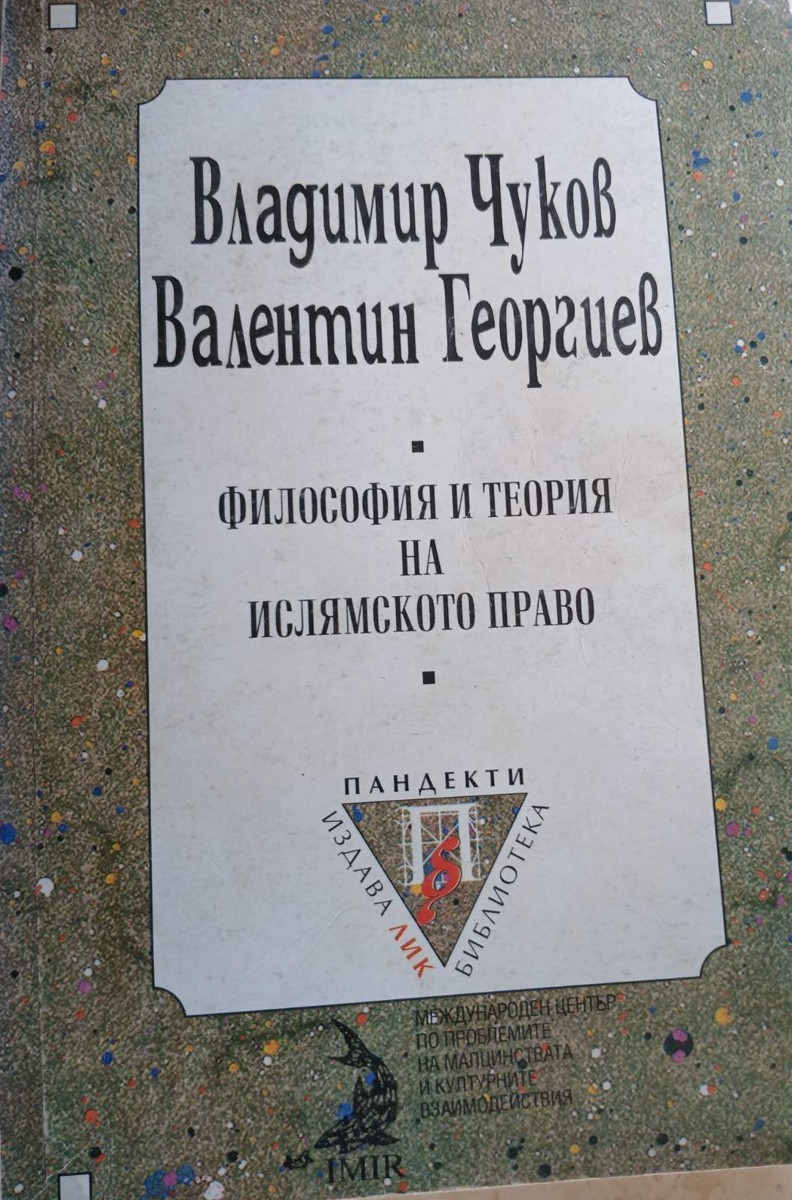
Philosophy and Theory of Islamic Law
Vladimir Chukov, Valentin Georgiev
This scientific analysis, entitled “Philosophy and Theory of Islamic Law”, represents a comprehensive, systematic, and in-depth study of the nature, historical development, philosophical foundations, and normative structure of the Islamic legal system (Sharia). The study aims to overcome superficial and fragmented perceptions of Muslim law by presenting it both as a unique civilizational phenomenon and as a complex, internally consistent jurisprudence comparable to classical European legal traditions.
In Chapter One (“Sharia as a Political and Legal Doctrine”), the author establishes the theoretical framework of the research by tracing the religious and philosophical context of monotheism in the Middle East and the emergence of Islam. Special attention is devoted to the fundamental doctrine of the Ummah—the religious and political community of believers in which the spiritual and secular realms are inextricably linked. On this basis, Sharia is analysed not merely as a collection of religious prescriptions, but as an all-encompassing political and legal doctrine. The chapter concludes with a comparative legal analysis between Islamic law and European jurisprudence, outlining their points of convergence, methodological differences, and mutual influences.
Chapter Two (“Origins of Islamic Law”) is dedicated to the historical evolution of the normative system. The study traces the process of transforming religious norms into positive law—from the early Quranic period and the practice of the Rightly Guided Caliphs to the institutionalization and centralization of state governance under the Umayyad Dynasty. Particular emphasis is placed on the emergence of early Islamic legal schools, which laid the foundations for the systematic interpretation and application of legal provisions within the expanding Caliphate.
In Chapter Three (“Philosophical Foundations of Islamic Law”), the focus shifts to the doctrinal and intellectual maturation of Islamic jurisprudence (Fiqh). The contribution of the first Sunni school of Malik ibn Anas and the methodological revolution carried out by Muhammad ibn Idris al-Shafi'i, who systematized the principles of law, are examined in detail. The chapter analyses the major Sunni legal-dogmatic schools (Madhhabs), sectarian movements, and key legal-philosophical works in the history of Islam. It also explores the legal doctrine of the Islamic state, the role of the administration of justice, the influence of European philosophical and legal thought on modernization processes, as well as the phenomenon of Taqlid (imitation and adherence to established legal precedent) in the historical development of the doctrine.
Chapter Four (“Sources of Islamic Law”) offers a detailed theoretical and methodological analysis of the normative hierarchy within Sharia. It examines the coherent system of legal sources, beginning with the primary divine sources—the Quran (its essence, methods of interpretation, and canonical readings) and the Sunnah (its origin, structure, and strict criteria for assessing the degree of authenticity of traditions). Next, the rational and secondary sources are analysed: the consensus of theologians and jurists (Ijma), analogical reasoning (Qiyas) with its logical constituent parts and properties, and the institution of doctrinal legal opinion (Fatwa). The chapter concludes with a scholarly classification of both the legal sources themselves and the Islamic jurists (Fuqaha) according to their competence and rank in legal scholarship.
Chapter Five (“Categories and Institutions of Islamic Law”) examines the internal dogmatic structure of Muslim law through the prism of modern general theory of law. It investigates the specifics of the lawmaking process within a system grounded in divine revelation, the legal status of the subjects of law, the nature of legal acts, and their legal properties. Special attention is given to the unique five-tier system of legal qualifications of human conduct (Al-Ahkam), as well as to precise Islamic legal terminology.
The Conclusion summarizes the main scholarly findings of the work. It emphasizes that Islamic law possesses a high degree of theoretical completeness, flexibility, and internal logic, the understanding of which is of key importance for contemporary comparative legal science and intercultural dialogue. The scholarly apparatus of the monograph is enriched with an index of names, a glossary of terms, an extensive bibliography, genealogies, and a diagram of the sciences of revelation, all of which facilitate orientation within the complex subject matter of Islamic jurisprudence.
| Publisher | LIK Publishing House (Pandekti library) |
|---|---|
| Original language | Bulgarian |
Contents
Chapter One. Sharia as a Political and Legal Doctrine
- Monotheism of the East
- The Emergence of Islam
- The Doctrine of the Ummah
- Sharia and European Jurisprudence
Chapter Two. Origins of Islamic Law
- The Quranic Period (Quranic Origins)
- The Rightly Guided Caliphs
- The Umayyad Dynasty
- Early Islamic Schools
Chapter Three. Philosophical Foundations of Islamic Law
- The First Sunni School (Malik ibn Anas)
- The School of Muhammad ibn Idris al-Shafi'i
- Major Legal-Dogmatic Schools (Madhhabs)
- Major Legal-Philosophical Works
- Legal Doctrine of the Islamic State
- Sectarian Legal-Dogmatic Schools
- Influence of European Philosophical and Legal Thought
- Sharia and the Administration of Justice
- Taqlid (Imitation / Legal Conformity)
Chapter Four. Sources of Islamic Law
- System of Sources in Sharia
- The Quran: Definition, Interpretations, Readings
- The Sunnah: Origin, Constituent Parts, Degrees of Authenticity
- Consensus of the Theologians (Ijma)
- Analogy (Qiyas): Definition, Constituent Parts, Properties
- Doctrinal Opinion (Fatwa)
- Classification of Islamic Legal Sources
- Classification of the Fuqaha (Islamic Jurists)
Chapter Five. Categories and Institutions of Islamic Law
- Lawmaking
- Subjects of Law
- Legal Acts
- Legal Qualifications (Al-Ahkam)
- Legal Properties
- Islamic Legal Terminology
Conclusion
Index of Names
Glossary of Terms
Bibliography
Reference Literature and Periodicals
Genealogies
- Diagram of the Sciences of Revelation