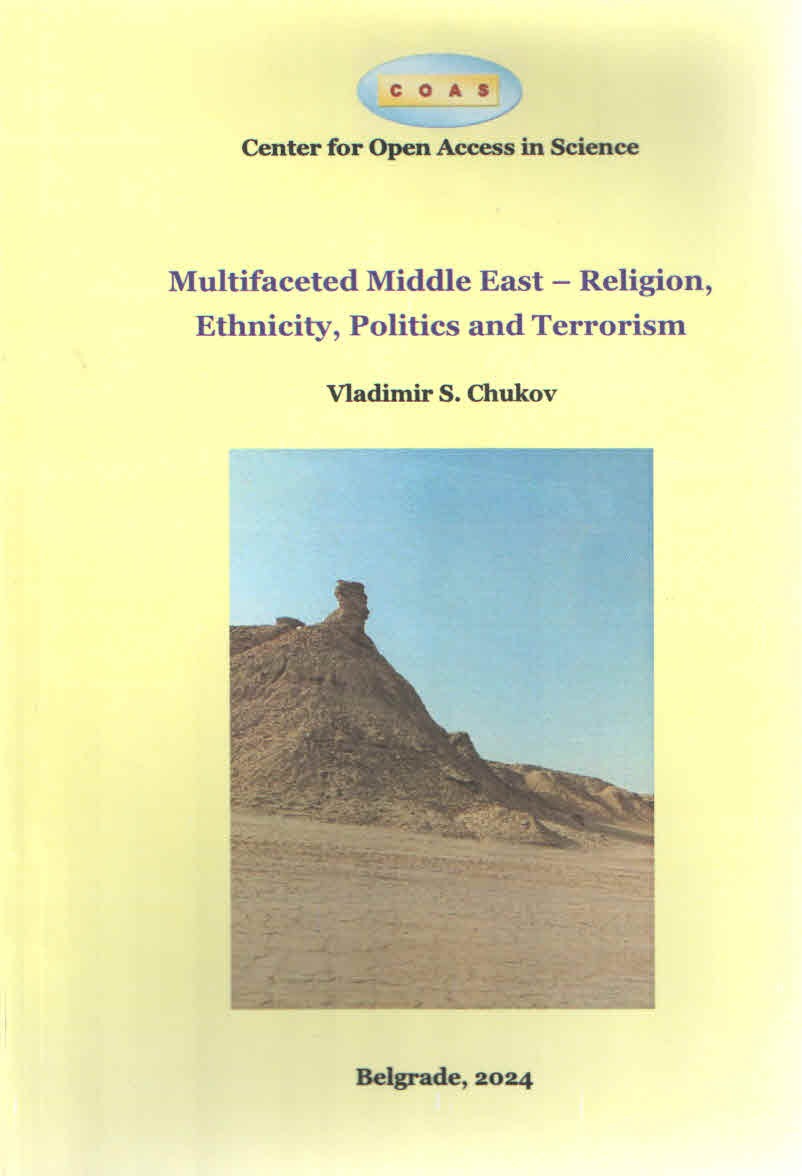
Multifaceted Middle East – Religion, Ethnicity, Politics and Terrorism
Multifaceted Middle East – Religion, Ethnicity, Politics and Terrorism offers an interdisciplinary examination of the deep historical, theological, ideological, and ethnic forces that shape the contemporary Middle East. Moving beyond surface-level geopolitical reporting, the study traces modern regional conflicts back to their doctrinal foundations, European intellectual parallels, and unresolved post-colonial demographic policies. Through a structured three-part analysis, the book demonstrates how eschatological beliefs, sectarian rivalries, extremist ideologies, and stateless nationalism converge in one of the world’s most volatile regions.
Part I: Religion, Ideology, and Historical Clashes
The opening section establishes the theological and historical framework necessary to understand modern ideological conflicts in the Middle East. It begins by examining the Islamic eschatological figure of Al-Mahdi—the prophesied redeemer who is expected to restore justice and establish an "ideal" Islamic state before the Day of Judgment. By analysing how different Islamic traditions interpret the emergence of Al-Mahdi, the text illustrates how messianic expectations have repeatedly been mobilized for political legitimacy, revolutionary movements, and state-building projects throughout history.
Building on these doctrinal foundations, the study explores the enduring schism between Sunni and Shia Islam, with a particular focus on how religious and political anti-Semitism has evolved within both branches. Rather than treating anti-Semitism solely as a modern reaction to Middle Eastern geopolitics, the analysis distinguishes between classical theological tropes and modern political instrumentalization, showing how external adversaries are frequently invoked to consolidate internal sectarian authority.
To place these dynamics within a broader cross-cultural context, the book turns to the European Reformation and the writings of Martin Luther (1483–1546). It examines Luther’s complex and often harsh theological views on both Judaism and the expanding Ottoman Islamic world. By juxtaposing Reformation-era polemics with Middle Eastern religious discourse, this chapter reveals how early modern European attitudes toward religious "others" share structural similarities with—and historically influenced—later political and religious exclusivism.
The first part culminates in an analysis of the State of Israel as a focal point where Christian, Islamic, and Jewish theological narratives intersect with modern statecraft. The text investigates the religious and civilizational friction surrounding Israel’s establishment and survival, highlighting how sacred geography, historical grievances, and competing religious claims transform territorial disputes into existential ideological struggles.
Part II: Extremism and Geopolitics
The second section bridges historical ideology and contemporary asymmetric warfare by focusing on the phenomenon of the Islamic State (ISIS). Through a political and philosophical lens, the book interrogates the blurred boundary between traditional Islamic concepts of the Caliphate and modern global terrorism. It examines how ISIS manipulated classical jurisprudence, apocalyptic prophecies, and the doctrine of takfir (excommunication) to justify extreme violence while simultaneously attempting to construct a functioning proto-state. By dissecting the group's ideological architecture, this section clarifies how modern jihadist movements weaponize religious history to recruit followers, erase colonial borders, and challenge the legitimacy of the modern nation-state system.
Part III: The Kurdish Question in Syria
The final section narrows the analytical lens to a specific, often overlooked geopolitical arena: Northern Syria, or Rojava, and the historical trajectory of the Syrian Kurds. It begins by mapping the twentieth-century Kurdish migration waves into Northern Syria, driven largely by the collapse of the Ottoman Empire, the redrawing of regional borders, and harsh assimilationist policies in neighbouring Turkey. These demographic shifts laid the groundwork for decades of tension between the Kurdish population and the central authorities in Damascus.
The study then delves into the institutional marginalization of Kurds within the Syrian state, examining the artificial division between "internal" and "external" Kurds—most notably enforced through the 1962 Hasakah census, which stripped tens of thousands of Kurds of their citizenship, reducing them to stateless foreigners (ajanib) or unregistered residents (maktumeen). Alongside this state-led disenfranchisement, the chapter traces early Kurdish political mobilization through the transnational nationalist organization Khoybun (Xoybûn), founded in 1927, and contrasts it with the Syrian Ba'ath regime’s aggressive Arabization policies, culminating in the creation of the "Arab Security Belt" (al-Hizam al-Arabi) in the 1970s to alter the ethnic composition of the northern borderlands.
Concluding the regional case study, the final chapter explores the distinct socio-economic and spiritual-religious fabric of the Syrian Kurds. It highlights the interplay between traditional tribal structures, agrarian economic dependence, and chronic state underinvestment in Kurdish-majority regions. Furthermore, it examines the pluralistic spiritual landscape of Rojava—where moderate Sunni Islam coexists with Yazidi, Christian, and secular currents—demonstrating how this social and religious diversity has fostered a unique political culture distinct from both Arab nationalism and radical Islamism.
Conclusion
Ultimately, Multifaceted Middle East – Religion, Ethnicity, Politics and Terrorism argues that the crises of the modern Middle East cannot be understood through military or diplomatic timelines alone. Whether examining messianic statecraft, the ideological roots of anti-Semitism, the philosophical perversion of the Caliphate by ISIS, or the systemic statelessness of the Syrian Kurds, the book underscores that lasting regional stability requires confronting the deep historical, religious, and ethnic realities that continue to define identity and power across the region.
| Publisher | Center for Open Access in Science, Belgrade |
|---|---|
| Pages | 152 |
| ISBN | 9788681294116 |
Contents
Foreword
Part I. Religion, Ideology and Historical Clashes
- The Emergence of the Islamic Messiah Al Mahdi and His “Ideal” State
- Sunni versus Shiites – Political and/or Religious Anti-Semitism
- Reformation, Martin Luther (1483–1546), Anti-Semitism and Islam
- The Clash Between Christian and Islamic Religion – The State of Israel
Part II. Extremism and Geopolitics
- Political and Philosophical Discourse on the Border Between the Caliphate and Terrorism – ISIS
Part III. The Kurdish Question in Syria
- Kurdish Migration Waves to Rojava (Northern Syria)
- Kurds: “External” and “Internal” in Syria, Khaibun’s Organization and “Arab Security Belt” (Security Belt Forces)
- Socio-Economic and Spiritual-Religious Specifics of the Syrian Kurds